Perimeter Security
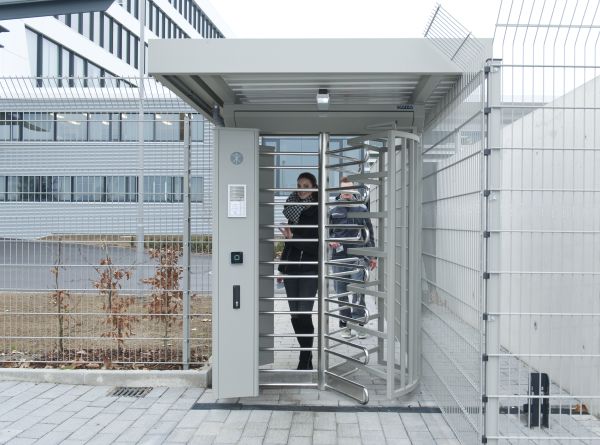
Heavy-duty, weatherproof perimeter turnstiles and vehicle barriers establish the outer defense line, managing flow rates, validating credentials, and routing logistics, visitors, and employees into authorized bays
Zero Trust access control for every layer of your data centre
Zero Trust Physical Infrastructure
In multi-tenant colocation and hyperscale environments, unmanaged contractor movement, shared rack keys, and tailgating represent major audit and uptime exposures. dormakaba protects critical server halls by embedding identity verification across six concentric security layers. By separating white space from support utility zones, physically enforcing single-person entry, and logging every rack access in real time, we help operators guarantee uncompromising data isolation and seamless audit compliance.

What it stops: A breach at the perimeter or parking bay should never give an intruder a straight path to your data halls. Relying on disjointed access points leaves dangerous visibility gaps across the campus. dormakaba enforces concentric street-to-rack defense - integrating perimeter boom barriers, turnstiles, building sensor barriers, mantrap interlocks, and rack locks into a single access architecture. Every layer acts as an autonomous security boundary, containing physical threats at outer rings long before they reach mission-critical servers.
Who it restricts: Third-party MEP and HVAC contractors require routine access to support infrastructure, but unmonitored movement into server halls creates severe uptime and other risks. dormakaba enforces strict physical segregation between white space (servers, storage, Meet-Me Rooms) and gray space (generators, chillers, power distribution). Contractors are automatically routed strictly to authorized mechanical zones via scheduled, time-bound credentials - guaranteeing third parties never step onto the server floor.
How it verifies: Standard RFID badges are easily misplaced, shared among co-workers, or cloned, compromising physical perimeter integrity. dormakaba eliminates reliance on single-factor credentials by combining smart cards, encrypted mobile passes, and biometric verification (facial recognition, fingerprint) into multi-factor authentication. Access rights are tied to verified individuals, dynamically checked at each transition layer, and instantly revoked from a central directory the moment a role changes.
What it solves: Human security guards cannot reliably prevent tailgating or piggybacking during high-traffic shift changes, leaving facilities open to audit penalties. dormakaba replaces human error with physical enforcement: Orthos personal interlocks (mantraps) utilize volumetric 3D and weight sensors to admit only one verified person at a time. Every access attempt and perimeter exception is logged in real time, giving operators tamper-proof traceability for SOC 2, ISO 27001, PCI DSS, and EN 50600 audits.
How it integrates: Managing door controllers, visitor kiosks, rack locks, and cameras across disparate platforms delays incident response and creates blind spots. dormakaba bridges physical security and IT management through the MATRIX platform and EntriWorX digital ecosystem. When a door forced open (DFO) or intrusion event occurs, the system flags the exact floorplan location, correlates the event with local CCTV, and feeds real-time syslog and SNMP traps directly into your SIEM and BMS, while cross-referencing Active Directory for instant personnel identification.


Involving access specialists early in the design process helps prevent costly rework and ensures compliant, workflow-driven door and hardware solutions. dormakaba works closely with healthcare design teams to coordinate clinical, safety, accessibility and performance requirements, delivering tailored BIM models and hardware schedules.
Heavy-duty, weatherproof perimeter turnstiles and vehicle barriers establish the outer defense line, managing flow rates, validating credentials, and routing logistics, visitors, and employees into authorized bays

Optical sensor barriers combine high throughput with touchless biometric and RFID validation, preventing tailgating at reception and employee checkpoints without slowing critical shift changes.
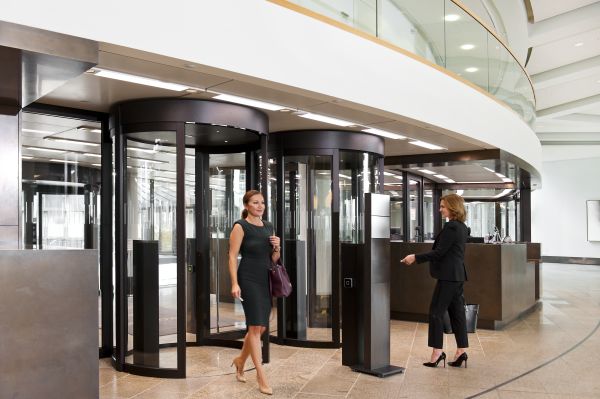
High-security revolving doors provide continuous, automated separation between administrative facilities and operational wings, eliminating unauthorized piggybacking through intelligent overhead sensors
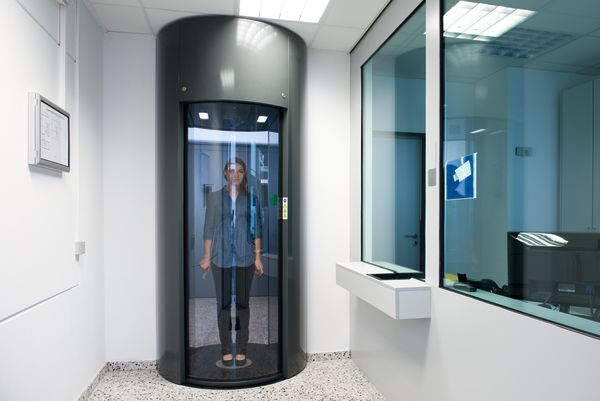
Physical mantraps (Personal Interlocks) equipped with specialised sensors and contact floor scales admit strictly one verified individual at a time, establishing an uncompromising barrier at the white space threshold.
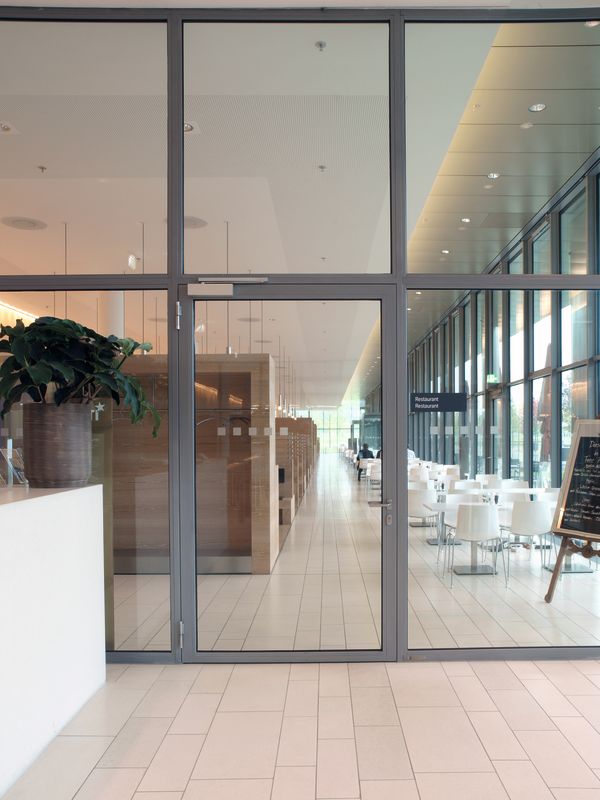
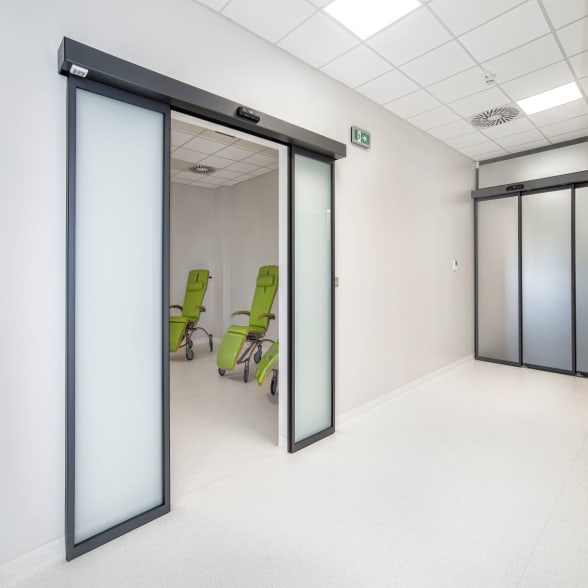
Precision cam-action closers, automatic electromechanical operators and high-security, self-locking emergency escape (panic) mortise locks overcome severe HVAC differential air pressure, ensuring acoustic isolation, energy efficiency, and immediate positive self-latching.
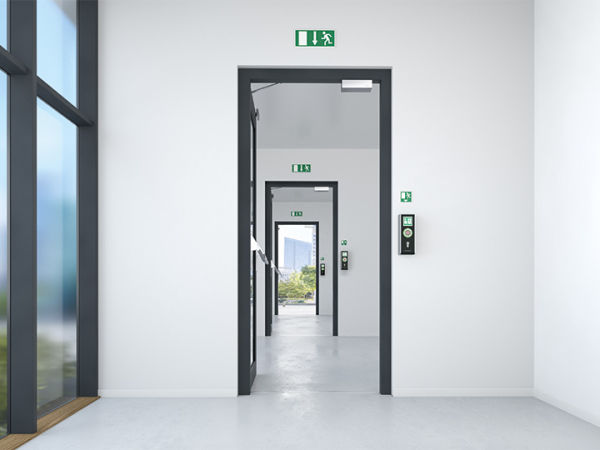
Electronically monitored escape route systems balance emergency life safety codes (EN 1125 / EN 179 / NFPA) with high-security containment, providing instantaneous fail-safe egress while preventing unauthorized backdoor entry.

Consult our data centre specialists for tailored street-to-rack security, compliance, and access control solutions. Get expert support with facility design, BIM integration, door scheduling, and life-safety compliance for new builds or upgrades.
Physical access control manages who can enter a data center and which areas they are authorized to access. Protection can be applied at multiple levels, from the site perimeter and building entrances to restricted rooms and individual server racks. Every layer enforces a different trust boundary; credentials are checked at each step, not just once at the front door.
dormakaba helps data centers secure access in layers, from the site perimeter to the server rack. Solutions can be tailored to the facility’s layout, user roles, authentication requirements, and operational needs, with support spanning planning, specification, and implementation.
Third-party facility engineers, MEP specialists, and generator technicians require regular access to utility infrastructure, but granting them general access passes introduces significant cross-contamination risks into live IT environments. Manual escorting by internal staff strains resources and causes maintenance delays.
dormakaba access architecture implements precise zoning that physically isolates white space (server suites, Meet-Me Rooms, storage arrays) from gray space (UPS systems, switchgear rooms, chiller plants). Using centralized identity rules, MEP contractors are issued time-delimited, schedule-based credentials routed strictly to mechanical wings, with turnstiles and interlocks physically blocking entry into technical data corridors.
Every security director knows that relying on guard vigilance or warning beepers does not stop someone from following an authorized colleague through a door. At the same time, rigid checkpoints that slow down engineering teams during major shift turnovers cause operational friction and tenant frustration.
The answer lies in separating high-flow throughput from high-security boundaries. At main receptions and employee portals, dormakaba Argus sensor barriers process authorized crowds rapidly with touchless optical sensors and biometric recognition. At the critical white space threshold, Orthos personal interlocks take over physical enforcement. Using integrated 3D volumetric sensors and contact weight scales, the interlock physically confirms that only one verified person has entered before opening the inner door - stopping piggybacking mechanically, with zero guesswork.
Compliance audits become complex and time-consuming when security teams must manually correlate paper sign-in sheets, disparate video feeds, and offline door controller histories to prove dual-custody or authorized access.
Through the MATRIX access management platform and EntriWorX ecosystem, every physical event - from vehicle gate entry to rack door unlatching - is consolidated into a centralized, tamper-evident log. Timestamped telemetry, door-forced-open alarms, and credential overrides feed continuously via Syslog and SNMP into your central SIEM or BMS. When auditors request physical access records for specific tenant spaces, operators export non-repudiable reports instantly.
Many data centers deploy advanced biometrics at the building entrance, yet protect multi-million-dollar compute racks with mass-produced, identical mechanical keys. These keys offer no access visibility, cannot be audited, and if misplaced, require re-keying entire rows of racks at significant expense.
PoE-networked smart rack locks extend access control directly to the rack door, establishing true micro-segmentation. Technicians authenticate at the rack handle using RFID cards, PINs, or mobile credentials, unlocking only the assigned rack for an authorized work window. Every opening attempt is tracked centrally, while high-security mechanical cylinders (such as pextra Q) provide a registered, fail-secure manual override for emergency resilience.